
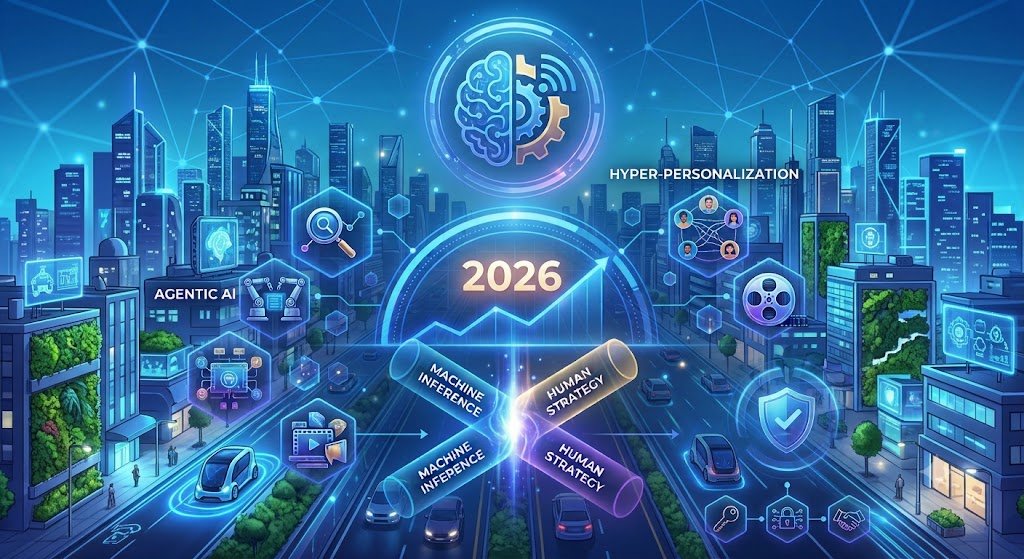
Beyond the Hype: How AI Became Marketing Infrastructure in 2026
Artificial intelligence has officially migrated from an experimental novelty to the invisible backbone of modern commercial strategy. Novelty fades; infrastructure endures. Organizations no longer query whether neural networks belong in their stack, but rather how deeply those networks should be woven into enterprise operations. The computational substrate now underpins customer relationship management, programmatic media buying, and real-time content synthesis. Siloed point solutions have yielded to unified cognitive architectures that process petabytes of telemetry instantaneously. Marketing without machine intelligence is now as unthinkable as commerce without the internet.
The Shift from Reactive Automation to Proactive Intelligence
Legacy automation operated on rigid, rule-based heuristics. If a user clicked a link, the system dispatched a pre-written email sequence; it was deterministic, linear, and fundamentally unintelligent. Today’s paradigm revolves around continuous probabilistic reasoning. Predictive models anticipate consumer intent long before an explicit action manifests on-screen. Instead of merely reacting to funnel drop-offs, intelligent ecosystems reconfigure user journeys in real time to prevent friction entirely. We have transcended simple task execution to enter an era of continuous synthetic foresight.
What Digital Marketers Must Know to Stay Ahead
Survival in this reconfigured domain demands a profound conceptual pivot. Technical literacy alone is insufficient; practitioners must cultivate algorithmic fluency and strategic synthesis. Marketers must learn to orchestrate multi-agent systems, interpret high-dimensional data, and maintain brand coherence across machine-synthesized touchpoints. The competitive moat is no longer access to capital or raw media spend, but the speed at which an organization translates machine inference into decisive commercial action.
From SEO to GEO: Winning the Generative Engine Optimization Battle
Why AI Answer Engines Are Replacing Traditional Search Results
The blue hyperlink list is an artifact of the past. Users no longer tolerate sifting through pages of ad-laden search engine results pages when generative answer engines deliver synthesized, contextualized summaries instantly. Conversational discovery platforms ingest query intent, cross-reference multidimensional indexes, and distill complex solutions into singular, conversational outputs. Consequently, organic site traffic from generic informational queries has plummeted. Brands that fail to appear within these synthesized answers risk complete digital erasure.
Structuring Content for Machine Understanding and AI Citations
Generative Engine Optimization (GEO) requires an overhaul of content architecture. Machine readability now trumps superficial keyword density. Content must be structured with explicit semantic hierarchies, rich JSON-LD schema markup, and verifiable epistemological anchors that large language models can parse with high confidence. Knowledge graphs dictate visibility. To earn citations in machine-generated answers, publications must present clear, authoritative facts, structured data tables, and dense information architectures that models identify as canonical sources of truth.
Balancing Brand Authority with AI-Driven Information Delivery
As algorithms compress narrative articles into bulleted summaries, brand voice faces systemic dilution. Marketers face a paradox: how do you project an evocative brand narrative when an intermediary AI strips away stylistic nuance? The solution lies in high-information-density thought leadership enriched with proprietary empirical research. Unique primary data, idiosyncratic expert opinions, and distinct intellectual property cannot be hallucinated or genericized by an engine. Authenticity becomes the sole defense against algorithmic homogenization.
The Rise of Agentic AI: Autonomous Workflows Take Center Stage
Moving Beyond Simple Chatbots to Independent Marketing Agents
Deterministic conversational bots have been replaced by autonomous agentic systems capable of multi-step reasoning, tool execution, and self-correction. Modern marketing agents do not merely parse user text; they possess agency. They formulate hypotheses, query internal databases, generate custom collateral, initiate cross-channel outreach, and audit their own output for accuracy. These autonomous agents operate as digital knowledge workers, handling end-to-end campaign execution with minimal human latency.
+-----------------------------------------------------------------------+
|                       AGENTIC AI WORKFLOW MATRIX                      |
+-------------------+---------------------------------------------------+
| Autonomous Stage  | Primary System Execution                          |
+-------------------+---------------------------------------------------+
| Hypothesis        | Evaluates real-time telemetry to spot market gaps |
| Orchestration     | Synthesizes copy, generates assets, sets bids     |
| Real-Time Audit   | Adjusts budget allocation based on cross-channel  |
|                   | conversion velocities                             |
+-------------------+---------------------------------------------------+
Automated Bidding, Budget Reallocation, and Real-Time Campaign Tweaks
Manual campaign management is entirely obsolete. Agentic frameworks monitor cross-channel media performance across milliseconds, dynamically shifting capital toward high-performing audience cohorts. If a creative variation underperforms in one demographic, the system automatically sunset that asset, generates a real-time variant based on trending sentiment, and reallocates the budget. Human intervention at this tactical layer only introduces inefficiency and lag.
The Human-in-the-Loop Framework: Maintaining Control and Vision
Unchecked autonomy invites existential risk, rendering robust guardrails non-negotiable. The modern marketer acts as an orchestrator and ethical governor rather than a tactical executor. Human-in-the-Loop (HITL) frameworks establish threshold parameters: agents possess full autonomy within pre-approved operational boundaries, but trigger mandatory human review when spending, tone, or strategy strays beyond prescribed guardrails. Strategy provides the direction; autonomy provides the velocity.
Hyper-Personalization 2.0 and Intent-Driven Journeys
Context-Aware Engagement: Delivering the Right Message in Real Time
Hyper-personalization has evolved beyond appending a first name to a subject line. Contextual engines process real-time environmental data—location dynamics, current biometric stress indices from wearables, localized atmospheric conditions, and micro-behavioral dwell times—to modify user interfaces dynamically. A single landing page now mutates into thousands of personalized variations, tailoring tone, color palettes, value propositions, and calls-to-action to match the psychological state of the individual visitor.
Predictive Customer Journeys and Anticipatory Marketing
Linear sales funnels belong to history. Today’s consumer movements are non-linear, unpredictable, and rapid. Predictive intelligence charts these erratic trajectories by evaluating historical cohort behavior alongside current signal velocity. Systems anticipate a customer’s need before the consumer explicitly formulates it, presenting proactive solutions precisely when latency yields maximum conversion impact. Marketing feels less like an intrusion and more like a helpful intuition.
Harnessing Zero-Party Data in a Post-Cookie Digital Landscape
The complete deprecation of third-party tracking mechanisms forced a reckoning that ultimate power lies in zero-party data—information explicitly and willingly shared by consumers. Interactive micro-experiences, value-exchange diagnostic tools, and adaptive preference centers incentivize users to disclose their priorities, stylistic tastes, and intent. When fed directly into privacy-safe machine learning pipelines, this hyper-accurate data powers hyper-targeted campaigns without breaching regulatory boundaries or consumer expectations.
Next-Gen Creative Production: Scaling Visuals and Copy Without Losing Soul
AI Systems vs. One-Off Shoots: Infinite Dynamic Asset Generation
The era of monolithic studio production shoots and months-long asset creation cycles is over. Neural media synthesis engines allow brand teams to generate photorealistic imagery, personalized video sequences, and bespoke audio in minutes. Dynamic asset engines automatically render thousands of tailored variants designed for distinct micro-segments, adjusting lightning, talent demographics, and product placement based on real-time viewer profiles. Scale is no longer constrained by production physics.
           +---------------------------------------------+
           |       ENTERPRISE CREATIVE ENGINE            |
           +---------------------------------------------+
                                  |
            +---------------------+---------------------+
            |                                           |
            v                                           v
  [ Generative Visuals ]                      [ Synthetic Copy ]
  • Dynamic Renderings                        • Real-time Translation
  • Demographic Tuning                        • Micro-segment Tone
  • Contextual Environments                   • Adaptive Messaging
            |                                           |
            +---------------------+---------------------+
                                  |
                                  v
                      +-----------------------+
                      | Multi-Variant Output  |
                      |   (Real-Time Scale)   |
                      +-----------------------+
Combating “AI Slop” with Authentic Brand Storytelling
An unintended consequence of infinite asset synthesis is the proliferation of generic, soulless content—often termed “AI slop.” As feed volumes surge with commoditized visual noise, consumer perceptual filters harden. Winning brands stand out by leveraging high-concept human imagination, visceral storytelling, and deliberate vulnerability. Machine intelligence builds the asset matrix, but human vision infuses the emotional resonance that builds lasting community and cultural relevance.
The Evolving Role of Creatives: Moving from Production to Direction
The creative stack has inverted. Copywriters, designers, and videographers are transforming into creative directors of algorithmic systems. Instead of spending weeks manipulating keyframes or drafting dozens of ad variants, creative professionals curate aesthetic guidelines, write foundational master prompts, refine generated outputs, and safeguard the brand’s stylistic integrity. Curation and direction are the supreme creative skill sets of this epoch.
Predictive Analytics and Strategic Decision-Making
Upstream Scenario Modeling: Forecasting Outcomes Before Spending Big
Capital allocation no longer relies on intuition or retrospective historical reporting. High-fidelity simulation environments allow strategists to run millions of synthetic market tests prior to deploying a single dollar of live ad spend. By modeling competitive reactions, macroeconomic shifts, and consumer sentiment fluctuations, upstream scenario engines forecast campaign performance with astonishing accuracy. Risk is quantified and mitigated in code before it touches the market.
+-----------------------------------------------------------------------+
|                    UPSTREAM SCENARIO MODELING                         |
+-----------------------+-----------------------------------------------+
| Simulation Variable   | Strategic Metric Analyzed                     |
+-----------------------+-----------------------------------------------+
| Competitor Action     | Real-time share of voice displacement risk    |
| Macroeconomic Shift   | Price sensitivity & conversion elasticities   |
| Creative Fatigue      | Decoupled engagement decay curves over time   |
+-----------------------+-----------------------------------------------+
Dynamic Attribution Models in Multi-Touch Conversions
Last-click and first-click attribution models were simplistic abstractions that distorted reality. Machine-learning attribution architectures analyze every micro-interaction across offline and online ecosystems simultaneously. By evaluating high-dimensional probabilistic conversion paths, these systems credit nuance—measuring how an ambient digital out-of-home display, a synthetic podcast spot, and an AI-generated search answer interact to drive conversion.
Bridging the CX Disconnect: Unifying First-Party Data Foundations
Predictive algorithms depend entirely on the quality of their underlying data architecture. Enterprise marketing operations must dismantle internal data silos, consolidating disparate transactional, behavioral, and customer support records into a unified data substrate. When customer experience (CX) touchpoints communicate seamlessly with the core predictive platform, the resulting operational flywheel optimizes every interaction across the entire customer lifecycle.
Ethical Marketing, Privacy, and Building Consumer Trust
Overcoming the Consumer Trust Deficit in AI Data Collection
As predictive systems grow increasingly sophisticated, consumer anxiety regarding surveillance and data exploitation intensifies. Suspicion breeds disengagement. Brands must actively address this trust deficit by abandoning opaque data-gathering tactics. Security is no longer merely a legal compliance requirement managed by IT; it is a vital brand promise that directly influences customer acquisition and retention metrics.
              +-------------------------------------------+
              |       CONSUMER TRUST TRIAD (2026)         |
              +-------------------------------------------+
                                    |
          +-------------------------+-------------------------+
          |                         |                         |
          v                         v                         v
  [ Zero-Party Exchange ]  [ Algorithmic Governance ]  [ Total Transparency ]
  Value for data          Audited for bias &       Explicit AI disclosure
  sharing                 brand safety             & control mechanisms
Navigating Algorithmic Bias and Brand Safety Safeguards
Unchecked machine learning models can easily amplify societal biases, misinterpret cultural nuances, or inadvertently place brand assets alongside toxic content. Organizations must institute continuous algorithmic auditing routines. Implementing rigorous fairness constraints and bias-detection pipelines ensures campaigns align with corporate values while protecting brand equity from sudden, algorithmically induced reputational damage.
Transparency as a Competitive Advantage: Disclosing AI Usage
Attempting to pass off synthetic assets as authentic human creations is a recipe for brand damage. Modern consumers value transparency. Forward-thinking companies actively disclose how and where machine intelligence is utilized, transforming technical sophistication into a point of pride. Explicit labeling, ethical AI pledges, and clear data usage policies build enduring consumer trust in an increasingly uncertain digital world.
The Future-Proof Marketer: Skills and Organizational Shifts
The Pod-Based Execution Model: Breaking Down Silos for Speed
Hierarchical marketing structures are too slow for an dynamic, algorithmically driven marketplace. Leading organizations have restructured into agile, cross-functional pods. These lightweight units assemble data engineers, creative directors, prompt architects, and growth strategists into tight execution loops. Operating with high autonomy, these pods leverage unified agentic stacks to test, iterate, and scale campaigns in hours rather than months.
Upskilling Teams for Prompt Engineering and Model Fluency
The core competency of the modern marketing team is prompt architecture and model fine-tuning. Employees must understand how generative engines process context, interpret latent space, and respond to structured inputs. Corporate training initiatives must prioritize upskilling staff in computational thinking, dataset curation, and iterative output refinement. The quality of your prompts directly dictates the quality of your market presence.
Balancing Tech Efficiency with Emotional Intelligence
As technical processes automate, uniquely human traits experience a dramatic surge in value. Empathy, emotional intelligence, strategic vision, and deep cultural intuition cannot be replicated by silicon. The future belongs to the “cyborg” marketer—an professional who seamlessly leverages computational efficiency to handle analytical tasks while dedicating their human energy to high-level strategic vision, relationship building, and genuine emotional connection.
Conclusion: Crafting Your 2026 AI Marketing Roadmap
Key Takeaways for Immediate Implementation
To win in 2026, marketing leaders must audit their current operational stacks, shed legacy systems, and implement a unified data architecture. Begin by deploying agentic workflows within contained tactical environments before expanding autonomy into broad strategic domains. Transition optimization strategies from legacy search mechanics to Generative Engine Optimization. Above all, prioritize trust and data transparency to maintain brand equity across every algorithmic touchpoint.
Final Thoughts: Embracing Continuous Experimentation
The pace of technological evolution will never be this slow again. Standing still is functionally identical to falling behind. Building a durable competitive advantage requires cultivating a culture of relentless experimentation, continuous learning, and bold operational adaptation. The tools have changed, the rules have been rewritten, and the strategic frontier is wide open for those ready to lead it.